Navigating the Eternal Egypt
A really nice application to browse conceptually related egyptian artifacts, with many features: visual navigation, possibility of creating personal "libraries" of artifacts, typed entities. The Eternal Egypt. Even if the links to the semantic web could be many, I have not found anything mentioning a possible openness of the data....what a shame!

IBM and CultNat worked in close collaboration to develop a content strategy capable of synthesizing the diversity of cultural information available to the project. Artifacts from seven museums and dozens of archaeological sites around Egypt would form the basis of a repository of information in English, French, and Arabic spanning Pharoanic, Greco-Roman, Coptic, and Islamic periods in Egyptian history. The teams started from two principles: first, that people naturally assimilate stories more readily than discrete, undifferentiated chunks of data and, second, that the best user experiences are those that adapt to the constraints and needs of the user. These two design points laid a foundation for the creation of the Content Management System (CMS).
The heart of the Eternal Egypt project, CMS is a web-based application built atop IBM Websphere Application Server and DB2 running on Linux. Fundamentally, the Eternal Egypt CMS is a story-making machine, a tool for weaving images, multimedia, and information about people, places, and objects into narratives. This is accomplished by treating individual content "elements" such as artifacts or biographical information as the building blocks of larger narrative "modules" which themselves can be grouped into stories. Reuseable and recombinant, these modules enable extreme flexibility in the on-demand creation of meaningful content for Eternal Egypt.
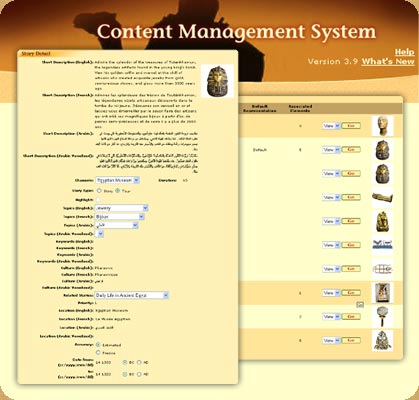
The Eternal Egypt CMS features full multilingual text input support, controls activities through workflow functions and user role assignment, and enables multiple users, working concurrently, to work on content. After a set of content is adequately organized, it can be tailored for output to a variety of flexible modes. CMS seamlessly transcodes content, delivering the most appropriate user experience to a fully interactive website, a lightweight text-only website, a handheld PDA-based "Digital Guide" in the Egyptian Museum, cell phones and portable network devices, and off-the-shelf educational courseware packages.