Reading Naples '44 as a database
I recently read Norman Lewis's Naples '44, and it stayed with me more than most books do.
Naples '44 is Lewis's diary from the year he spent as a British intelligence officer in Naples, from the Allied landings of September 1943 to October 1944. It's thin — a few paragraphs per entry. It's also one of the best things I've read about what military occupation looks like from street level. Hunger, the black market, bombs, and in between all of it the ordinary theatre of Neapolitan life: a saint's blood that has to liquefy on schedule, a requisitioned piano, the city aquarium emptied to feed an official banquet.
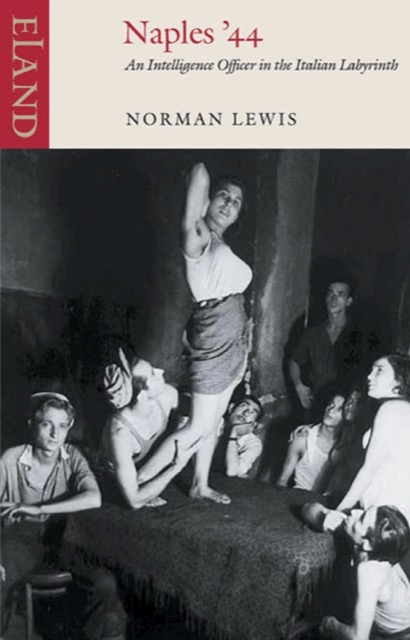
Part of why it landed is that I've spent time in many of the places he describes. Reading stories of that much suffering and misery, set in streets I know, and less than a hundred years ago — that does something to you.
So I decided to take the book apart and build a small website out of it: naples44.michelepasin.org. Partly to hold on to what the book is about, as an interactive index I can come back to. Partly as a test of how far I could get using Claude to do the work.
Taking notes by talking to Claude
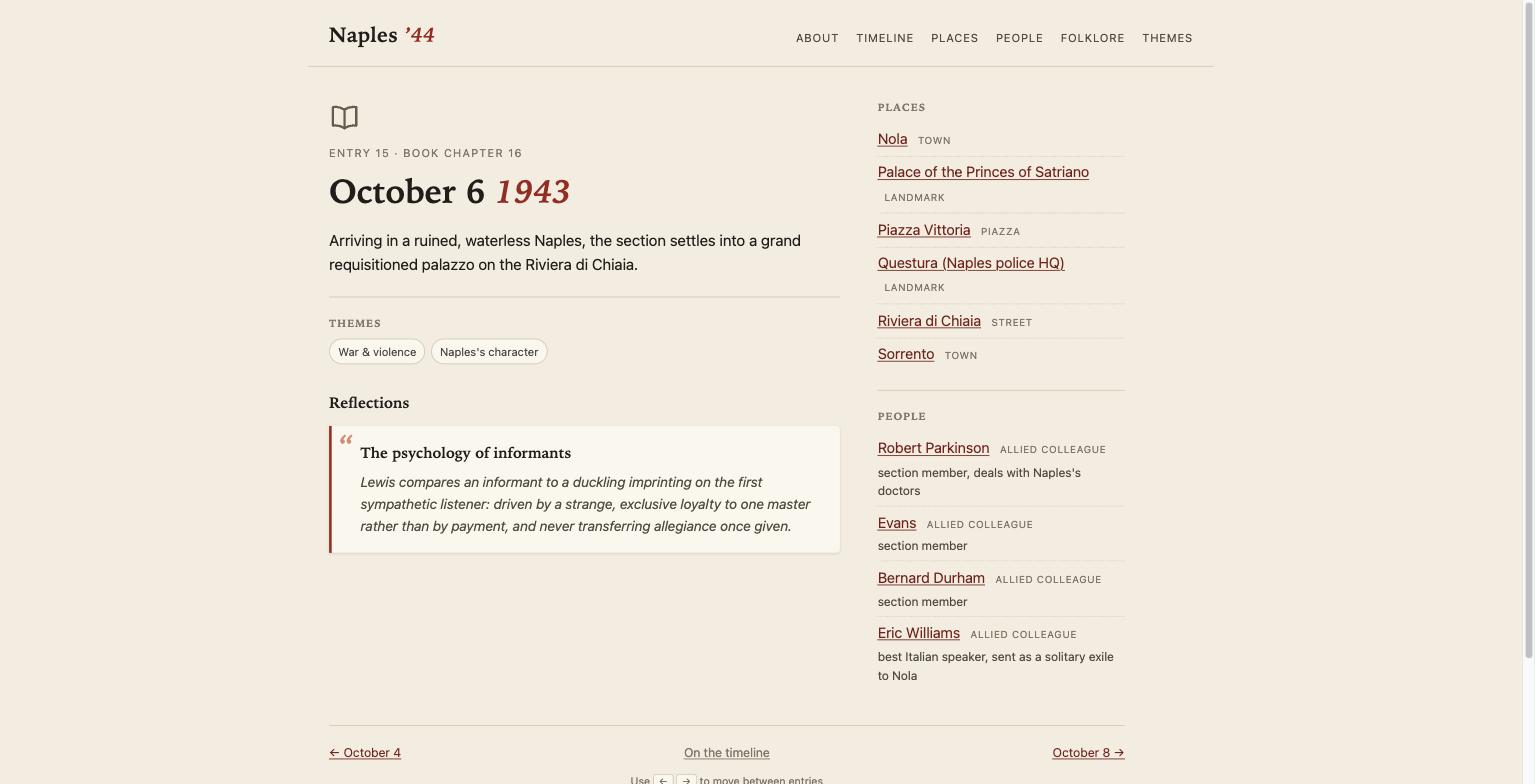
I didn't read Naples '44 on paper. I listened to it on Audible, on walks and commutes, and I took notes by talking to Claude as I went — telling it what had just happened, which places and people I wanted to keep track of, what a passage reminded me of.
That turned out to be a genuinely new way to take notes on a book. I've always meant to annotate as I read, and I've always been too lazy to actually do it: stopping to write breaks the flow, and you can't type on a walk. Doing it by conversation removes the friction. It's less like keeping a commonplace book and more like going through the book with someone next to you — you can argue with the text, ask "wasn't that the same officer from the Salerno chapter?", and let the running index build itself out of the back-and-forth.
By the end, that conversation had turned into a small structured dataset.
The unit is the entry. There are 108 of them, each with a date, a short summary in my own words, and a set of tags. I kept track of themes (11 of them — the evil eye, Allied conduct, the Camorra, survival), places (129), recurring people (37), and a running list of saints, feasts and superstitions (31). Lewis keeps circling back to the same handful of subjects, so most of the tags fell out of the book on their own.
What surprised me is how much the tagging changed the listening. Deciding whether an entry is "about" the black market or "about" Allied conduct — when it's plainly about both — forces you to say what the entry is really doing. Naming a place means deciding whether two vague references point at the same street. It's interpretation, not extraction — and having something to talk it through with makes you do more of it, not less. The dataset is a record of my reading of the book, not a neutral index of it.
The timeline
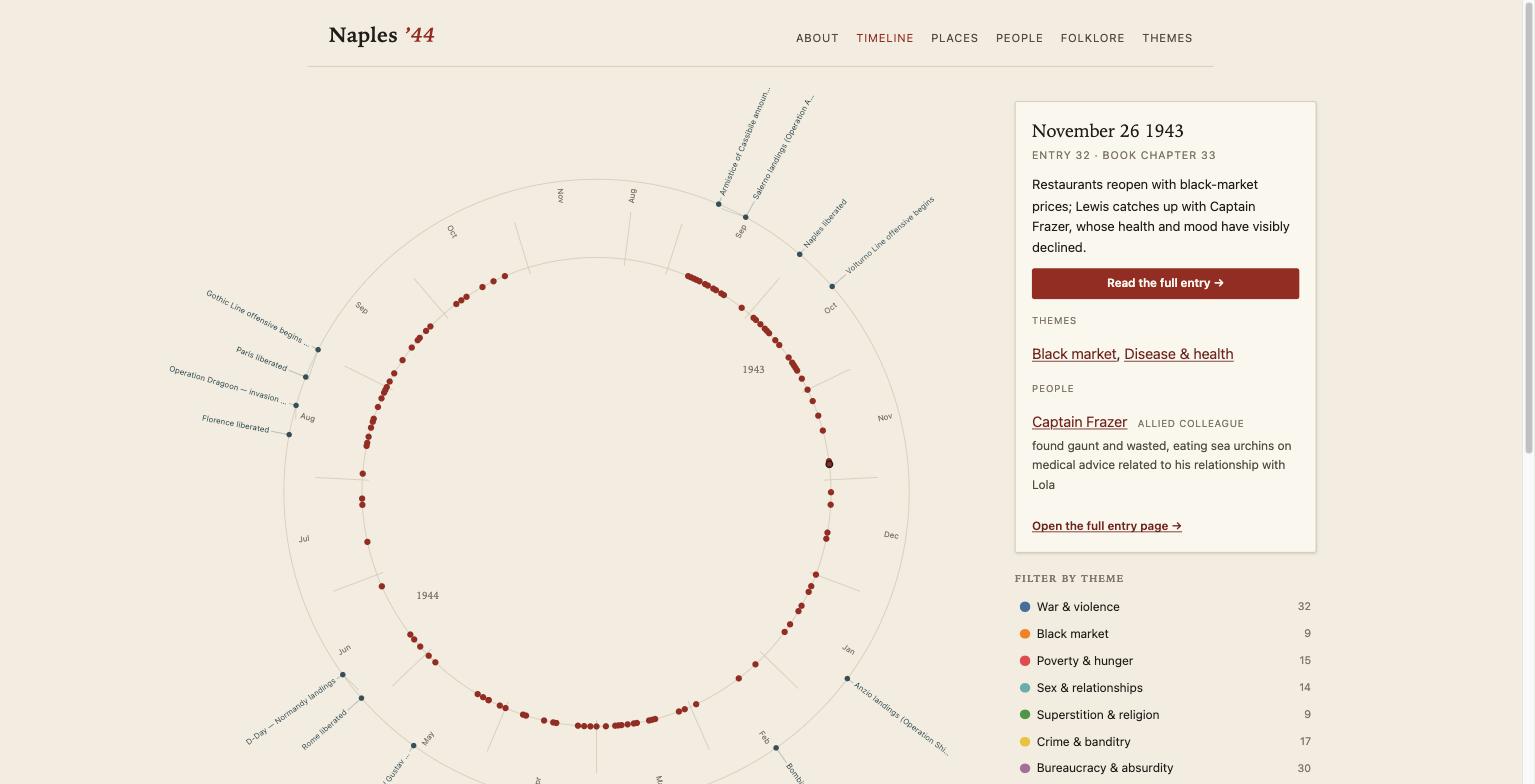
The main view is a circular timeline. The inner ring holds Lewis's 108 entries in date order. The outer ring marks 20 events of the wider war — the Anzio landings, Monte Cassino, the liberation of Rome — on the same axis.
The point of putting them together is the juxtaposition. While the Allied armies are stuck below Cassino through the winter, Lewis is writing about a woman who rents out her daughters, or the etiquette of a Camorra funeral. The military history and the view from one desk in Naples run in parallel, and you can see where they touch.
Hover an entry and you get its summary and tags. The theme filters light up every entry that touches a subject, so you can pull the "evil eye" thread through the whole year in one move.
A page for everything
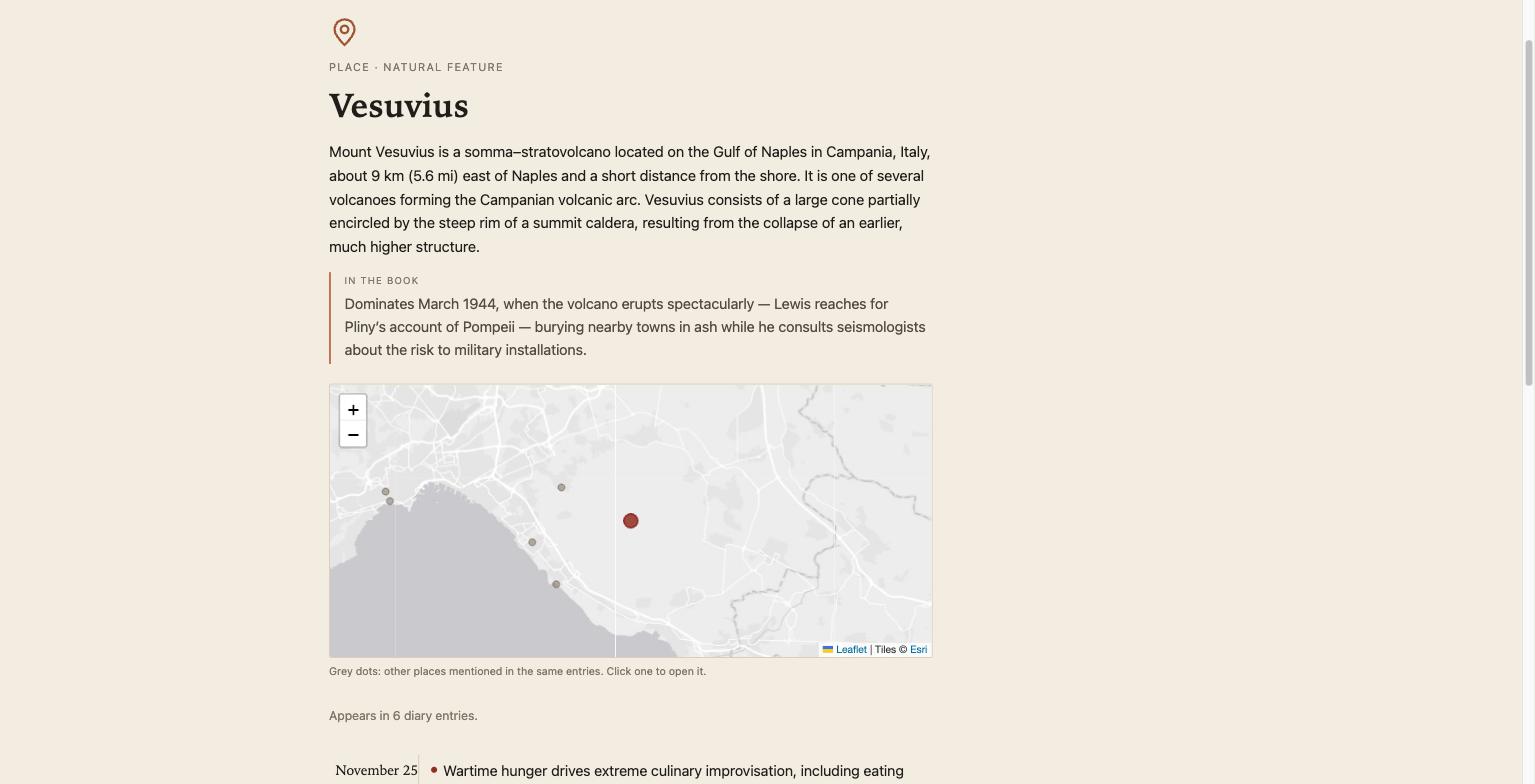
The other half of the site is flatter. Every place, person, saint and theme has its own page — a description, a note on what it's doing in the book, and a chronological list of every entry it appears in. Places also get a map: 114 of the 129 are geocoded, so you can see Lewis's Naples as a scatter of points, most of them within a few streets of each other.
This is the part I keep coming back to in my own work. People of Medieval Scotland, Wittgensteiniana, and now this — they're the same move. Take a text, pull out the entities, give each one a stable URL and a page that gathers every mention. It's an old idea, basically an index with hyperlinks, but it still produces something you can't get by reading front to back.
How fast this now goes
The plumbing is nothing clever. It's a Django app with a SQLite database and an admin interface I use to edit the data, and then the whole thing gets wget'd into static HTML and served from GitHub Pages. No server running anywhere. I've written about this pattern before — it's my default now for small sites that are really just a database with a nice front end. The visualisation is D3, vendored, no CDN. Source on GitHub.
What's new is the speed. A few years ago, building this as a Django application — models, admin, importers, templates, the timeline — would have taken me weeks, maybe months of evenings. This took a few days, working with Claude.
The judgement didn't go away. Someone still has to decide what counts as an entity, whether two mentions are the same person, what a theme means, and whether each summary is faithful to the book. I went over every one of those summaries. But the mechanical work — the models, the migrations, the import scripts, the geocoding, the D3 boilerplate — mostly just happened, at a pace that still surprises me.
I'm planning to package the workflow into a skill: point it at a text and a list of entity types, get back a navigable site like this one. More on that once it exists.
The book is still the point
If anything the site is an argument for reading Naples '44 slowly. Every summary is deliberately a paraphrase, never Lewis's own words — partly for copyright, and partly because doing the compression — even with an assistant to help — is what makes you look at a passage twice.
I built this mostly to find out what a book looks like once you've taken it apart. The answer, at least for this one: a year, a few hundred fragments, and the same dozen preoccupations coming round and round.