Book Summary: Quiver, don't Quake
Faced with AI, most creative people feel a tremor: you can read it as fear, and quake, or as excitement, and quiver. That's the argument in miniature of Quiver, don't Quake: How Creativity Can Embrace AI by Nadim Sadek (Mensch, 2025). Sadek wants us to quiver:
The feeling isn't one of fear, but of a thrilling drama. The feeling of standing on the verge of an opportunity to be creative in ways we're only just beginning to imagine.
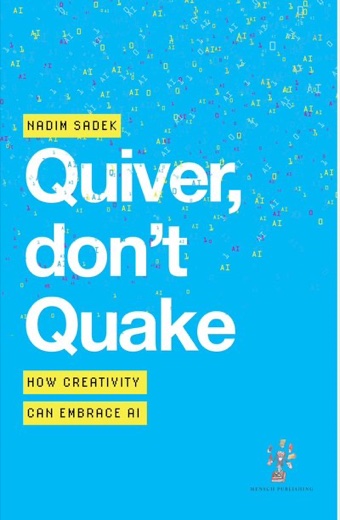
A book for creatives
A word on who this book is for. If you're already AI-pilled, you won't find much new here. It's written for creative people who struggle to see AI in a positive way, and mostly hear about it as a threat to their craft. Creative in a wide sense: artists and musicians, but also architects, designers, writers and programmers. I'm a creative at heart, and that's why it landed with me.
Most of what I read about AI and creativity is either hype or alarm. Sadek is optimistic without being naive: he gives a whole interlude to why we should quake, and a chapter to his critics.
His starting point is that creativity has always been held back by craft. Mastering an instrument, a camera or a chisel took years, money and access, and for most people the ideas never got out. In his words, how many masterpieces were lost "not for lack of creative spark, but for lack of a key to the workshop"? AI could hand that key to many more of the 8 billion people on the planet.
He also coins a word for what working with AI feels like. Not anthropomorphism, pretending the machine is a person, but Panthropism:
We're entering into what I call Panthropism, a dialogue with the distilled essence of all human knowledge, accomplishment, and creativity.
What stays with me most is the practical advice that goes with it. Treat AI as a partner in a conversation rather than a vending machine. Ask for fifty ideas and have the confidence to discard forty-nine. And defend your why: be the guardian of your project's intent and emotional core. As someone who makes things, I found that inspiring. It made me want to make more, which is more than most books on AI do.
Where I part ways
In a world of frictionless creation, the scarce thing is human taste in service of a purpose, and taste is formed by exactly the friction AI removes.
That's my working thesis after reading Sadek. I agree with him that once generating things is cheap, selection and taste are what count. Where I part ways is on where taste comes from. Juniors learn it doing routine work, musicians learn it at the instrument, and those are the parts AI is best at taking away. The value of the Panthropic is real, but the "someone" in the conversation is you.
Sadek gives a whole chapter to his critics (Emily Bender, Nick Cave, Timnit Gebru, Sherry Turkle and others) and answers most of them. Two get only a general closing: Jaron Lanier on provenance and Cory Doctorow on attention. They're also the two closest to my own work, and where I think there's more to say than the book does.
A map of the arguments
I turned my notes into an interactive Quiver, don't Quake field guide. It has:
- the quotes I found most inspiring;
- nine themes that run through the book, each with what Sadek says and the context around it: counterpoints, evidence and links to background reading;
- the critics from chapter 9, with Sadek's reply to each;
- a quiver/quake dial: slide it to switch every topic between the book's optimistic reading and the counter-reading 🙂
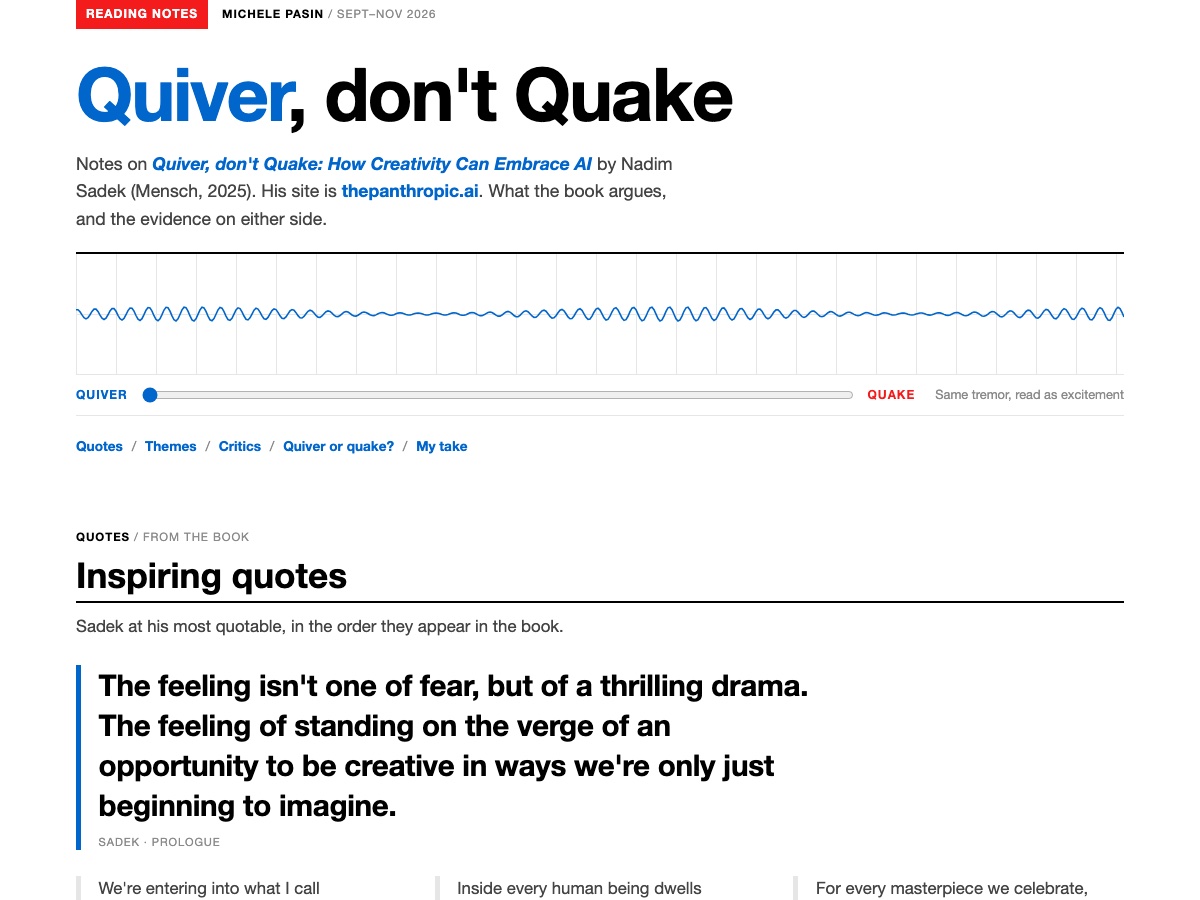
It's a fun way to revisit the book, and to see the arguments for and against creative AI side by side.
Cite this post
Michele Pasin. Book Summary: Quiver, don't Quake. Blog post on www.michelepasin.org, 13 November 2026.
Talk back / comments via github