A Dream of Venice, with Claude as Editor
My children can read Italian. Most of their classmates can't. Back in July 2023 I wanted to read the book Un sogno a Venezia by Štěpán Zavřel to their class at school, so first I had to put it into English. Recently I have picked up that project again and used Claude to review it — it's impressive what AI can do with language translation.
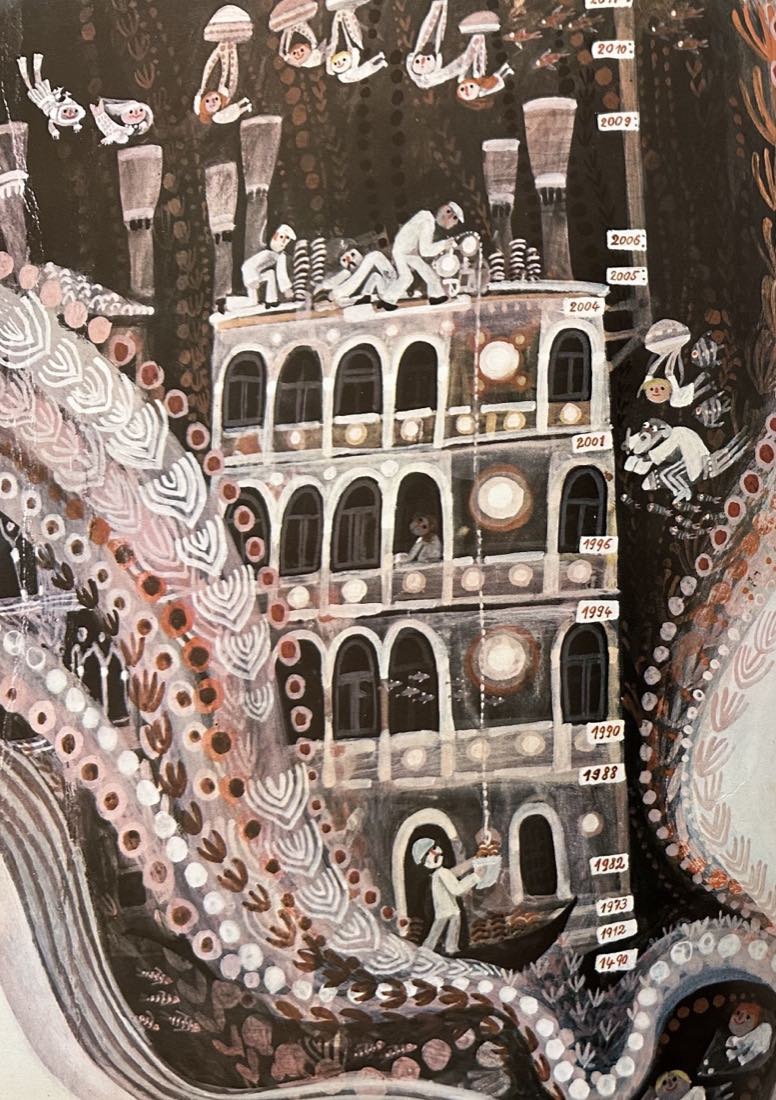
Un sogno a Venezia means "A Dream in Venice." A boy called Marco falls asleep worrying about a drawing he owes his teacher. A little mermaid taps on his window and takes him down to see Venice as it will be one day: on the seabed. They swim through St Mark's Square and into the golden basilica. They pass the Doge's Palace, where an octopus guards the empty rooms and plays cards against himself. Children play hopscotch with the fish. It is strange, and gentle, and a little sad.
Zavřel was a Czech illustrator who spent much of his life in a small town in the Veneto region (Italy), where the foundation named after him still champions children's book illustration.
There is no English edition, so I translated it myself and built a small website for it: zavreldream.michelepasin.org. Each page is one of Zavřel's paintings, full screen, with the text beside it. You can read it as a slideshow, as one long scroll, or as a book with pages that turn. Nothing clever underneath — a Django app that produces static HTML, and the code is on GitHub.
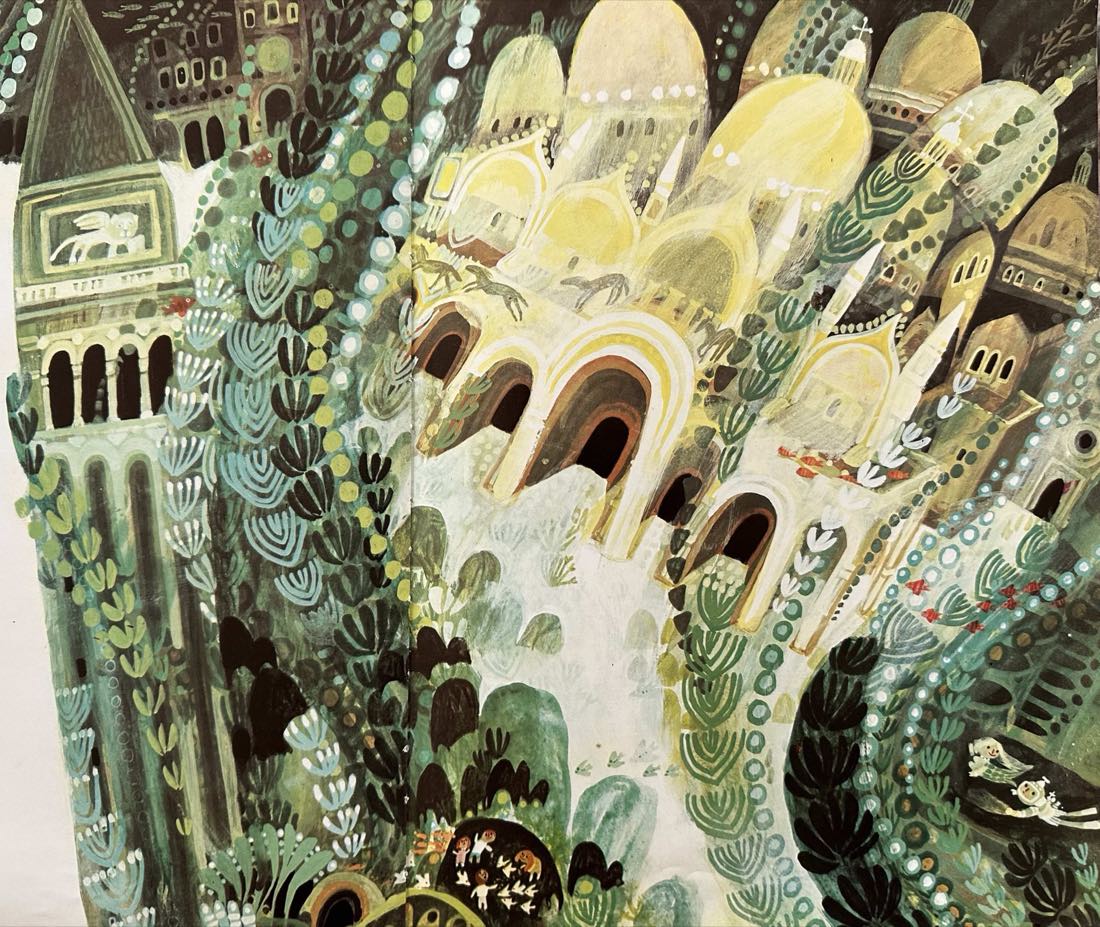
From A Dream in Venice by Štěpán Zavřel.
The city really is sinking
The premise isn't invented. Venice was built on millions of wooden piles driven into the mud of a lagoon, and it has been settling into that mud ever since. For a stretch of the twentieth century it settled faster, because factories on the mainland pumped groundwater from under the city for decades, until Italy banned the practice in the 1970s.
The bigger threat now is the sea rising to meet it. Measured against the water, Venice sits roughly 25 cm lower than it did in 1900, and the gap keeps widening. The high tides that flood St Mark's Square — the acqua alta — were once rare. Now they come dozens of times a year. A set of mobile barriers called MOSE can seal the lagoon against the worst surges, but it was built for today's sea, not the one we are heading towards.
Zavřel drew the book in 1975. In it, the children are told to imagine Venice underwater and to paint what they see. Fifty years on, that reads less like an art lesson and more like a forecast.
Translating with AI in the loop
Here is the part I didn't expect: translating with an AI in the loop is properly addictive.
I did the first pass myself, the honest way, one sentence at a time. Then I handed it to Claude to check. It started pulling at threads I couldn't see any more, because I had been staring at them too long. And once it found one, I wanted it to check the next page, and the next.
The easy things to catch are the italianisms — phrases that are grammatical in English but that no English speaker would choose. When Marco says the drowned city can't be real, the mermaid answers "Ma sì". I had written "But yes, replies the little mermaid." Claude's version: "Oh yes it is!" replies the little mermaid. Elsewhere my characters kept "arriving in front of" buildings — a word-for-word lift of arrivare davanti a — where English just says "coming to" them.
The harder things are in the dialogue. Italian punctuates speech loosely: the tag folds in with commas, the quotation marks are often dropped. Carry that habit across and you get:
"It's not possible! he exclaims, it's not possible!"
when English wants:
"It's not possible!" he exclaims. "It's not possible!"
In one line, the sea-children beg Marco to bring help. I had crushed two sentences together and lost a word along the way: "We've been waiting for so long come and save!" Claude put it back: "We have been waiting so long for you to come and save us!" I know exactly what the Italian says. I wrote the broken version anyway, and I read past it a dozen times.
I want to be clear about what this is and isn't. The AI did not translate the book. The wording is mine, and I threw out plenty of its suggestions. It is closer to having an editor who has read the page forty times and is still paying attention on the forty-first.
What writing becomes
I keep wondering what this does to writing over the next few years.
Not translation as a profession — that is already turning over. I mean the small daily act of getting a sentence to say what you meant. A comment on a pull request. A message to a colleague you don't want misread. A children's book you are turning into English so a room full of kids can follow along.
We are heading somewhere the distance between "roughly what I mean" and "exactly what I mean" costs almost nothing to close, for anyone, at any time. Mostly that is wonderful. It is also a little strange. Some of my worst sentences are the ones that taught me the most, and I don't know what teaches you that once the friction is gone.
The class got their story in the end, though. That part is done.
Cite this blog post:
Comments via Github:
See also:
2023
2021
2017
paper Data integration and disintegration: Managing Springer Nature SciGraph with SHACL and OWL
Industry Track, International Semantic Web Conference (ISWC-17), Vienna, Austria, Oct 2017.
paper Fitting Personal Interpretation with the Semantic Web: lessons learned from Pliny
Digital Humanities Quarterly, Jan 2017. Volume 11 Number 1
2015
2013
paper Fitting Personal Interpretations with the Semantic Web
Digital Humanities 2013, University of Nebraska–Lincoln, Jul 2013.
2012
2011
2010
2009
2007
paper PhiloSURFical: browse Wittgensteinʼs Tractatus with the Semantic Web
Wittgenstein and the Philosophy of Information - Proceedings of the 30th International Ludwig Wittgenstein Symposium, Kirchberg, Austria, Aug 2007. pp. 319-335