Book Summary: Deep Work (2016)
I finally got round to reading Deep Work by Cal Newport (2016). The book's central idea is that deep work, i.e. prolonged stretches of focused time without distractions, has become largely underrated in today's always-on internet world. And that is not good.
The book's argument didn't strike me as revolutionary or particularly new. I think anyone with some kind of advanced education (academic or not) knows exactly how important focused work is. Still, the book is a convincing reminder that in many jobs deep work is no longer seen as essential.
Deep work is underrated
So we should make a conscious effort to make room for it in our lives, and to get others to recognise its importance. Yes, I am talking to you, business managers and time-suckers!
Newport frames it as a bet on the future, which he calls the Deep Work Hypothesis:
The ability to perform deep work is becoming increasingly rare at exactly the same time it is becoming increasingly valuable in our economy. As a consequence, the few who cultivate this skill, and then make it the core of their working life, will thrive.
If depth is so valuable, why do so many workplaces drift the other way? Partly because shallow work is easier in the moment. But mostly because it's visible:
In the absence of clear indicators of what it means to be productive and valuable in their jobs, many knowledge workers turn back toward an industrial indicator of productivity: doing lots of stuff in a visible manner.
Answering emails quickly and turning up to every meeting looks like work. Two hours of uninterrupted thinking doesn't, even when it's the thing that actually moves a project forward.
Making room for it
The more practical half of the book is about how to protect that time. Newport describes four ways to schedule deep work, from the monastic (cut out shallow obligations altogether) to the journalistic (go deep whenever a gap opens up). His monastic example is Donald Knuth, who gave up email entirely:
Email is a wonderful thing for people whose role in life is to be on top of things. But not for me; my role is to be on the bottom of things.
Most of us can't do that, of course. But the underlying point holds for everyone: concentration is a skill you train, not a habit you simply decide to adopt.
A field guide
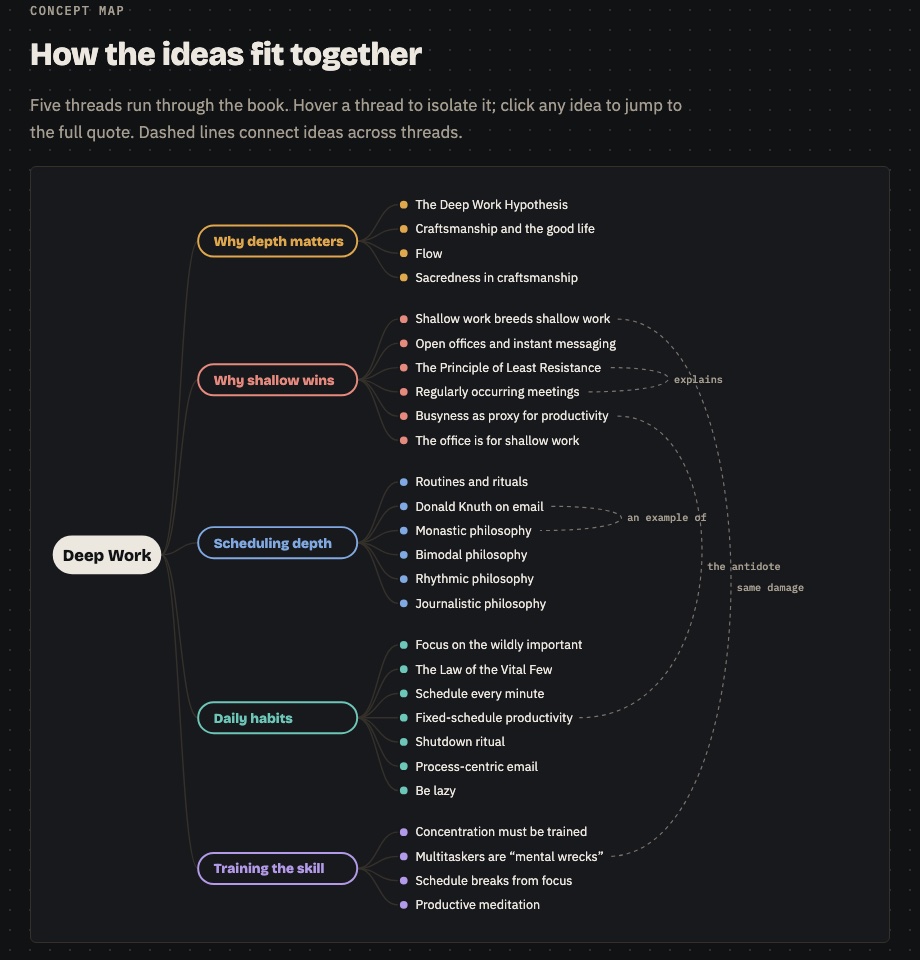
I saved the passages I found most inspiring and turned them into a one-page Deep Work field guide. It has a concept map of how the book's ideas relate to each other, the four scheduling philosophies drawn as sample weeks, the daily habits, and every quote in full.
The original notes are also available as a GitHub Gist
Changelog
- October 11, 2026: New AI generated HTML field guide added